 |
||
 SI joint dysfunction? Dr. John Stark
|
||
|
|
|
|||||||
| iSpine Discuss SI joint dysfunction? Dr. John Stark in the Main forums forums; Last October, at the NASS meeting in Toronto, I was fortunate to have attended a breakout session with a LENGTHY ... |
 |
|
|
LinkBack | Thread Tools | Display Modes |
 02-11-2009, 11:15 PM
|
||||
|
||||
 SI joint dysfunction? Dr. John Stark
Last October, at the NASS meeting in Toronto, I was fortunate to have attended a breakout session with a LENGTHY presentation on SI joint dysfunction. One of the presenters was Dr. John Stark. This session was standing room only… I spent the first half in the doorway, struggling to listen, but I got a seat for the second half and was seated next to some researchers and doctors that I know. I know that I’m easy to impress, but discussing the SI issues with the professionals was very interesting. They were equally impressed.
The pictures he showed of the SI patients who could NOT SIT due to severe SI pain looked EXACTLY like many clients I’ve seen. The stories of spine surgery after spine surgery with no positive result, then having symptoms resolved after SI surgery were quite remarkable. Note that I don’t think that SI surgery is the be all end all treatment, but this diagnosis and treatment option may provide hope for many people who have been dismissed as psych problems, failed back surgery syndrome, etc…. Also, I hope that as ruling out this diagnoses becomes part of the protocol, some patients with SI issues can avoid unnecessary spine surgery and go straight to the problem. It’s very interesting that many years ago, SI fusions were a common procedure that was a substantial part of the arsenal that the spine surgeons had available. They have fallen out of favor and are so far removed from the mainstream that getting a proper diagnosis for SI can be difficult or impossible. You have to run into a doctor that really knows about it and embraces the possibility. I’ve seen other diagnoses, like piriformis syndrome that even many of the surgeons I know and love, won’t take seriously. After the session, I went out to dinner with a doctor that I’d met the previous year at NASS in Austin… Dr. George Lewinneck. (“I’m a thin verneer of Harvard Medical School under a thick layer of Wisconsin farm boy.”) His “I’m just an old country doctor, Jim” persona is very charming, but he’s a brilliant man with a very unique background. His take on Dr. Stark’s data was especially interesting because he’s been a spine surgeon long enough to have done SI fusions in the past and stopped (as had most of the industry.) He seemed to be excited about revisiting SI and also about the newer SI fusion techniques that Dr. Stark presented. I just spent half an hour on the phone with Dr. Stark discussing some very problematic cases. I’ve very pleased to find him, as he seems to be at a place in his career where he is happy to get the difficult cases. I look forward to working with him and I’ll keep you posted as I learn more.
__________________
1997 MVA 2000 L4-5 Microdiscectomy/laminotomy 2001 L5-S1 Micro-d/lami 2002 L4-S1 Charite' ADR - SUCCESS! 2009 C3-C4, C5-C6-C7, T1-T2 ProDisc-C Nova Summer 2009, more bad thoracic discs! Life After Surgery Website President: Global Patient Network, Inc. Founder: www.iSpine.org 
|
|
02-12-2009, 03:55 AM
|
||||
|
||||
|
Very Interested in SI Issues
Hi Mark,
I have an interest in SI joint issues as I feel that I am suffering from this as well as my back issues. I had x-rays taken a few years ago & I found out from the report (not from my doctor, surprise) that there were sclerotic changes in the SI joints. I had an SI joint injection last November, but had maybe a 20% improvement in pain. I have to wonder if my back pain prevented me from feeling any additional relief from the injection. I still have a little "hip" pain since my fusion surgery but it's only been 3 1/2 weeks. Guess we'll have to see if it resolves itself over the next few months. Thank you for the info & I look forward to hearing more updates on this issue. Karin
__________________
Disc Bulge C4/C5, Disc Degeneration T11/T12, Bi-Lateral tears L5/S1, Diagnosed w/ Lumbar Disc Derangement w/ Radiculopaphy. Treatment: IDET, Percutaneous Discectomy, SI Joint Injection, Facet Block. All failed. Empire BC/BS Denied Coverage for ADR-lost all of my appeals. MVP also denied coverage. Anterior/Posterior Fusion L5/S1 -1/20/09
|
|
02-12-2009, 12:25 PM
|
|||
|
|||
|
Mark, thank-you. Very, very interesting. Now, while I am waiting as patiently as I can on my couch with my heating pad for my SI joint injections to kick in, I have a very ignorant question to ask you. Does having my L6-S1 fusion have any bearing positive (or God forbid, negative) on the SI joints? How far from my fusion are the SI joints?
 I seriously wonder, based on my recent cat scan showing arthritic condition to my SI joints, if fusing them would be the solution to all my problems. As my hip replacement surgery draws nearer these are some of my paranoid questions. I seriously wonder, based on my recent cat scan showing arthritic condition to my SI joints, if fusing them would be the solution to all my problems. As my hip replacement surgery draws nearer these are some of my paranoid questions. Btw, sorry I missed your phone call the other day. We used the window of my hours of relief from the injections last friday to drive to our cabin in northern Minnesota for the weekend. It was incredible to be in the car for that trip with no pain.  Cindylou
__________________
bicycle accident 6/01: 2 compression fractures @ T12-L1; vertibroplasty; 4/06: right hip labral tear & arthroscopic repair; 4/07: lumbar prodiscs @ 3 levels, L3-6 by Dr. Bertagnoli; 7/02/08: ALIF L6-S1; 7/30/08: reopened to remove bone cement, leaked onto S1 nerve root; 8/08: pulmonary embolism, double pneumonia, collapsed left lung, pleurisy, pleural effusion; ALIF fusion complete; 3/10/09: SI Joint Fusion by Dr. Stark; Jury still out.
|
|
02-12-2009, 06:04 PM
|
||||
|
||||
|
Karen and Cindylou,
Note that many diagnostic injections are referred to by some physicians as 'infiltrations'. I assume that refers to the need to infiltrate the specific tissues with the anesthethetic, steriod, contrast, whatever the injectant is. While we would like this to be pure science, much of this is art and luck. False positive results may occur when the injectant flows somewhere unanticipated and generates relief from a location that is other that the target area. False negative results may occur when the injectant does not get to the target tissue because of missed injection, or proper injection with some reason that the injectant doesn't flow as anticipated... scar tissue, stenosis, etc... Note that mixed results are also possible. By the time most of us get to this type of diagnosis, we have big multi-focal pain problems and periods of relief and bad episodes from each problem is on it's own cycle. It's difficult (or impossible) to unwind it all. I don't know how tricky SI injections are. I look forward to learning more from Dr. Stark. Cindylou, how close is he to you? I hate saying this because it is truly my "dumb-assed layperson's opinion", but I believe that I see more problematic cases in people with transitional segments... L6-S1 (lumbarized S1), less so for the L4-S1 (sacralized L5). One of the more interesting things that Dr. Stark discussed in his presentation was regarding adjacent or transitional segment disorders following treatment of our lumbar spine. When we fuse L4-L5-S1, L3-4 becomes a 'transitional segment' and is subject to higher loading. While I mentioned (above) the concept of treating the spine instead of the dysfunctional SI joints (as part of a missed diagnosis), there is also the issue adjacent segment disease following the reconfiguration of the lumbar spine with fusion, ADR, auto-fusion, collapsed segments, etc... After your lumbar surgery, does the SI joint become a transitional segment BELOW the lumbar spine as it's the next mobile joint in the system? I wonder if CindyLou might have a double whammy... is the SI a transitional segment in between a dysfunctional hip AND lumber spine??? This is all interesting stuff... I look forward to wathing this discussion unfold as we learn more. All the best, Mark
__________________
1997 MVA 2000 L4-5 Microdiscectomy/laminotomy 2001 L5-S1 Micro-d/lami 2002 L4-S1 Charite' ADR - SUCCESS! 2009 C3-C4, C5-C6-C7, T1-T2 ProDisc-C Nova Summer 2009, more bad thoracic discs! Life After Surgery Website President: Global Patient Network, Inc. Founder: www.iSpine.org
|
|
02-12-2009, 06:37 PM
|
||||
|
||||
|
Thanks Mark! I'll have to take a look at Dr. Stark's website. Much appreciated.
__________________
-Justin 1994 Football Injury 1997 Snow Skiing Injury Laminotomy L4/L5 (3.7.97--17 years old) 1999 & 2003 MVA (not at fault both times) Grade V Tears L4/L5 & L5/L6 2-Level ProDisc® L4/L5 & L5/L6* *lumbosacral transitional vertebra (11.15.03--23 years old) Dr. Rudolf Bertagnoli -- dr-bertagnoli.com Pain-free for the last 4.5 yrs. 5.14.09 DSS with Dr. B. I'm here to help.  Only checking PMs currently. Only checking PMs currently.
|
|
02-12-2009, 10:34 PM
|
||||
|
||||
|
I just had another conversation with Dr. Stark.
I asked about RF ablations for painful SI joints, much like we see in other area (facets). It has been tried with little success and he does not do them. He says that the SI is too highly inneverated from several sources, so it's not reasonable to consider ablation. You have to either ablate too much, or not do a complete ablation... hence the poor results. (This is me trying to paraphrase what Dr. Stark said... If I'm mistating this, I hope he'll let me know so I can correct this.) The most important part of our conversation had to do with the discussion of hip dysfunction as it relates to SI pain. Yes, hip issues that cause alignment or mechanical issues can increase the loading on the SI joints, much like a fused or collapsed spinal segment can overload the adjacent segment. I was specifically asking hypothetical questions about an anonymous person who was pain free for some time following an SI injection, but has hip replacement surgery coming up. While it's impossible to properly discuss any case without real data or examinations, he said that just like with the spine surgeries, he frequently sees patients who have hip replacement surgery with no improvement in their hip symptoms. Then, addressing the SI resolves the symptoms. Remember, you can have degenerated joints that are not painful. It's possible for SI joint disfunction to mimic hip problems. Note that you can have hips that are painful and SI that is painful too. It may be that we need one, the other or both. However, if there is any reason to suspect possible SI involvement, I'd get properly evaluated by someone who knows SI joint dysfunction BEFORE undergoing hip surgery. Do your homework, make informed decisions. Lastly, we discussed the improvements in fusion technology. We could not get into specifics because I had an appointment, but the technology has advanced a long way from the SI fusions of old. I look forward to learning more! All the best, Mark
__________________
1997 MVA 2000 L4-5 Microdiscectomy/laminotomy 2001 L5-S1 Micro-d/lami 2002 L4-S1 Charite' ADR - SUCCESS! 2009 C3-C4, C5-C6-C7, T1-T2 ProDisc-C Nova Summer 2009, more bad thoracic discs! Life After Surgery Website President: Global Patient Network, Inc. Founder: www.iSpine.org
|
|
02-13-2009, 12:37 AM
|
|||
|
|||
|
Mark, again, thank-you. And I needed our phone conversation today. I decided to overnight you my Cat Scan, so you should receive it tomorrow morning, 10:30-ish. Keep me posted.
Thanks again, Cindylou
__________________
bicycle accident 6/01: 2 compression fractures @ T12-L1; vertibroplasty; 4/06: right hip labral tear & arthroscopic repair; 4/07: lumbar prodiscs @ 3 levels, L3-6 by Dr. Bertagnoli; 7/02/08: ALIF L6-S1; 7/30/08: reopened to remove bone cement, leaked onto S1 nerve root; 8/08: pulmonary embolism, double pneumonia, collapsed left lung, pleurisy, pleural effusion; ALIF fusion complete; 3/10/09: SI Joint Fusion by Dr. Stark; Jury still out.
|
|
02-13-2009, 01:06 AM
|
||||
|
||||
|
OK... please GPN clients... keep info about sending films and similar info away from iSpine. I really want this to be a patient community and not have anything to do with GPN.
__________________
1997 MVA 2000 L4-5 Microdiscectomy/laminotomy 2001 L5-S1 Micro-d/lami 2002 L4-S1 Charite' ADR - SUCCESS! 2009 C3-C4, C5-C6-C7, T1-T2 ProDisc-C Nova Summer 2009, more bad thoracic discs! Life After Surgery Website President: Global Patient Network, Inc. Founder: www.iSpine.org
|
|
02-13-2009, 01:13 AM
|
|||
|
|||
|
Sorry. Forgot.

__________________
bicycle accident 6/01: 2 compression fractures @ T12-L1; vertibroplasty; 4/06: right hip labral tear & arthroscopic repair; 4/07: lumbar prodiscs @ 3 levels, L3-6 by Dr. Bertagnoli; 7/02/08: ALIF L6-S1; 7/30/08: reopened to remove bone cement, leaked onto S1 nerve root; 8/08: pulmonary embolism, double pneumonia, collapsed left lung, pleurisy, pleural effusion; ALIF fusion complete; 3/10/09: SI Joint Fusion by Dr. Stark; Jury still out.
|
|
02-13-2009, 01:59 PM
|
|||
|
|||
|
This is interesting information. I have continued to have some SI joint issues post ADR surgery and it has responded favorably to injections so far. I would not look forward to another surgery as I am already at four major operations and holding. I look forward to hearing more about this in the future.
Terry Newton
__________________
1980 ruptured L4-L5 1988 ruptured SI-L5 1990 ruptured C5-C6 1994 ruptured C6-C7 1995 Hemi-Laminectomy C5-C6, C6-C7 Mayo Clinic Bicycle Accident 2004 MRI, EMG, Facet Injections, Epidural Blocks, Lumbar Discogram. Stenum Hospital Surgery November 4, 2006 Prestige Disc C5-C6, C6-C7 Maverick Disc S1-L5, L4-L5
|
|
03-14-2009, 11:43 PM
|
||||
|
||||
|
It’s just a little more than a month after I made my initial post about Dr. Stark. I’m so happy to be posting this update.
Over the last weeks, I was fortunate enough to spend a couple of days with Dr. Stark and his staff. There is so much about his approach to spine and they way his office runs that I really like. Remember that in my days before being a patient advocate, I was a spine patient and chronic pain patient for years. We've all spent too much time in offices staffed by people who might say something like, “My job is OK, if it just wasn’t for those spine patients!” Dr. Stark and his staff are the opposite of that and are like a breath of fresh air. His office is in the Medical Arts Building in old Downtown Minneapolis. The building is very cool. The first think you might notice when you enter his office is the doctor’s great golden retriever, Jake! Dr. Stark is very down to earth and easy to talk to and really cares about his patients. Here is Dr. Stark with Jake and his wonderful office manager, Betty: 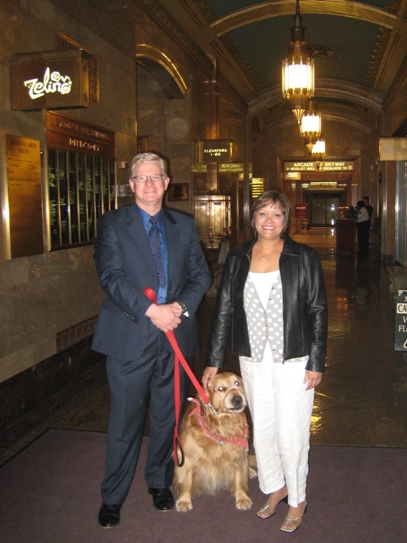 Betty keeps the office running smoothly and really seems to take an extraordinary interest in the patients’ lives. “Many of them just need a little extra hand holding,” she says, and she’s happy to do it. Dr. Stark’s interest in SI joint dysfunction come from his willingness to keep searching for answers. Too many spine patients have continuing pain after seemingly successful surgeries. He is not apt to dismiss a patient with the “scar tissue” diagnosis, or write them off as drug seekers, malingerers or psych problems. He believes that in most cases, you can find and solve the problem. Most of the people who work with me have heard me say, “the surgeon does not want to be your doctor, he wants to be your surgeon.” Dr. Stark wants you to be an ex-patient after your problems are solved. But, if your problem is not solved, he wants to be your doctor and will continue to care for you and search for a solution, rather than turf you to pain management. I was not quite convinced about SI joint dysfunction until I had the opportunity to speak to so many of his patients, including many recent and not-so-recent post-op patients. I was amazed to hear about people with classic sciatic symptoms, some after failed spine surgeries, who reported waking from the SI joint fusion to discover that their leg pain, weakness and numbness were all gone! In my travels, I’ve been lucky to be able to spend time with many surgeons who truly pioneered new technologies. One said to me, “First I was a heretic, then I was a pioneer, then many said that they invented it!” I think that Dr. Stark is making the transition from heretic to pioneer. I’m shocked to discover that 6 years into my GPN experience, I’m finding something that I truly expect to represent hope for a significant percentage of failed spine patients. This ‘outside the box’ diagnosis may be something that is frequently overlooked by a surgeon community that does not embrace the diagnosis and does not understand the new type of repair that Dr. Stark and his colleagues have developed. His style of SI joint fusion is NOTHING like the old techniques that were not very effective. It’s a pleasure to talk to him as he has such a passion for what he does and is clearly on a mission. He has refined and improved the procedure through the years and continues to do so. I spoke to Cindy today. She’s 4 days post-op and has already been home for a day. It’s very early to tell because she still has substantial surgical pain but she’s reporting that her pre-op pain does not seem to be present. We don’t know how good she’ll get or what the future holds, but I look forward to watching her recovery. I truly believe that she stands a better chance for success because of Dr. Stark’s ability to take a step back and get the big picture instead of having a narrow focus. He’s very interested in learning about other technologies and I was surprised that he wanted to come to dinner and meet my Minneapolis client’s. With just a few days notice, everyone came out. This photo appeared in another thread, but it belongs here too: Front row, left to right, Tim - husband to Sandra (2 ProDisc L 4.5 years) mmglobal (2 Charite's 6.5 years), Michele (3 ProDisc-L w/vertebroplasty 3.5 years), Michele's husband Clinton, Back row, left to right, Rick - husband to Cindylou (3-level ProDisc, 2 years), Betty (Dr. Stark's office manager), Dr. John Stark 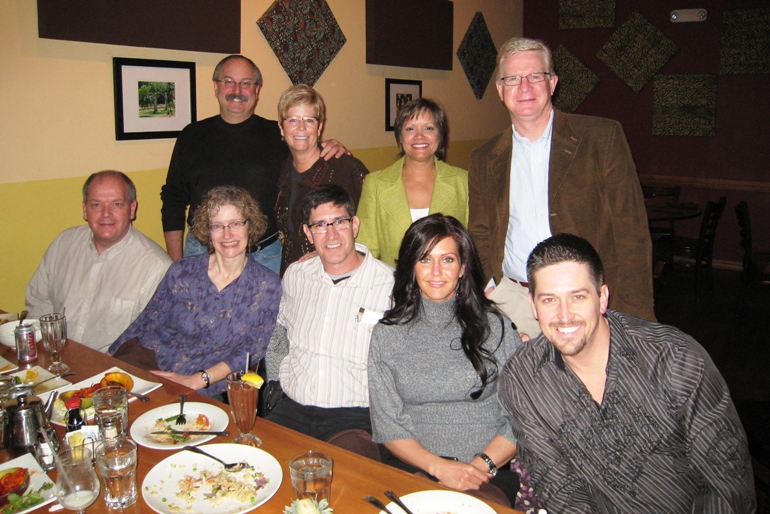 I think we really opened his eyes to the potential success for multi-level ADR surgery as Michele, Sandra and I all had such excellent results. Cindy’s 3-level ADR is very well done and apparently successful, but her ongoing SI pain (hopefully) has left her still seriously impaired. Hopefully, the SI fusion surgery done 2 days after this picture was taken will give her another chance for a more normal life. I can’t thank Dr. Stark enough for his warm hospitality and the amount of time and care he took to educate me about his work. I truly believe that he’ll be helping many GPN clients in the future! All the best, Mark
__________________
1997 MVA 2000 L4-5 Microdiscectomy/laminotomy 2001 L5-S1 Micro-d/lami 2002 L4-S1 Charite' ADR - SUCCESS! 2009 C3-C4, C5-C6-C7, T1-T2 ProDisc-C Nova Summer 2009, more bad thoracic discs! Life After Surgery Website President: Global Patient Network, Inc. Founder: www.iSpine.org
|
|
03-15-2009, 06:30 PM
|
|||
|
|||
|
is this me..
I was told for a long long time I had SI joint dysfunction by PTs. I was treated for it for over a year and seemed to have gotten better re the symptoms I experienced that were attributed to SI joint dysfunction but who knows cuz w/failed back and the other stuff going on I would imagine as you stated Mark it would take *an expert* in this particular area to really identify if this is part and parcel of the problem that could be fixed or all of it that could be fixed.
This is interesting. I doubt WC would pay for one more consultation anywhere ~ (to date I've not told any of my OSS docs about the worsened t score even)...
|
|
08-29-2009, 12:43 AM
|
||||
|
||||
|
It's been a while and I thought I should update you. I just spoke to Dr. Stark. He called me from the MN State Fair. The Sacroiliac Society has a booth there. (Are they presenting medical info or selling cotton candy?)
His office continues to impress me. Everyone I send is very pleased with the thorough exam, ease of communication with Dr. Stark, and his VERY helpful staff. What a breath of fresh air. It's interesting that when I went out there, he seemed very reluctant to adopt ADR... hadn't been proven yet. We had some very lively discussions when I was there and in the weeks that followed. He was pretty blown away by the crew we had at our dinner (above). He called me in June. He was at the airport in Denver. He had just finished the ProDisc-C class and had ridden to the airport with Dr. Bertagnoli. The exchange in both directions about ADR and SI joint dysfunction and the new fusion techniques must have been amazing. In the following weeks, Dr. Stark attended the ProDisc lumbar class in Dallas. I'm pleased to have participated in bringing him around and look forward to hearing more about his experiences as he does more and more ADR cases. All the best, Mark
__________________
1997 MVA 2000 L4-5 Microdiscectomy/laminotomy 2001 L5-S1 Micro-d/lami 2002 L4-S1 Charite' ADR - SUCCESS! 2009 C3-C4, C5-C6-C7, T1-T2 ProDisc-C Nova Summer 2009, more bad thoracic discs! Life After Surgery Website President: Global Patient Network, Inc. Founder: www.iSpine.org
|
|
08-29-2009, 03:10 PM
|
|||
|
|||
|
Very cool update Mark! Kudos to you! I think I see him pretty soon for a follow up so will be good to chat with him a bit about all of this. Thanks for the info!
__________________
bicycle accident 6/01: 2 compression fractures @ T12-L1; vertibroplasty; 4/06: right hip labral tear & arthroscopic repair; 4/07: lumbar prodiscs @ 3 levels, L3-6 by Dr. Bertagnoli; 7/02/08: ALIF L6-S1; 7/30/08: reopened to remove bone cement, leaked onto S1 nerve root; 8/08: pulmonary embolism, double pneumonia, collapsed left lung, pleurisy, pleural effusion; ALIF fusion complete; 3/10/09: SI Joint Fusion by Dr. Stark; Jury still out.
|
|
| Bookmarks |
|
|





 Linear Mode


