 |
||
 Choosing ADR or fusion
|
||
|
|
|
|||||||
| iSpine Discuss Choosing ADR or fusion in the Main forums forums; I am considering whether to do ADR or fusion at L5/S1. I probably wouldn't consider fusion at all, ... |
 |
|
|
LinkBack | Thread Tools | Display Modes |
 10-27-2007, 05:56 PM
|
|||
|
|||
 Choosing ADR or fusion
I am considering whether to do ADR or fusion at L5/S1. I probably wouldn't consider fusion at all, but for this being a single level, and the level where (I believe I've heard) preserving motion is least critical. Some of the new minimally invasive fusions look to me a lot less traumatic than ADR, tho surgical trauma is only one of many factors to consider.
There are a million points on which to compare the two procedures. I am mostly laying out the questions here, and will really appreciate hearing any thoughts or information you have. Both procedures should be equally effective at eliminating a discogenic pain generator, as in both the symptomatic disc is completely removed. (Or does ADR leave a piece of the annulus in place?--that always bothered me.) So the questions are, (A) What are the risks of each procedure/device. I see five main categories here, the first three being the most common: Damage to (1) adjacent discs (advantage ADR over fusion, which puts increased stress on adjacent segments); (2) facets (a risk for ADR, less so for fusion?); and (3) nerve roots (from the surgery=equal risk in either ADR or fusion? Perhaps the new fusion technique, approach through the sacrum, offers the least neurological trauma. trans1.com.) The choice among these first three risk factors might be dictated by what each patient considers most vulnerable in his/her own body. Also to be considered is how fixable each of these three problems is. (1) No one wants more discs to fail after major surgery to correct the first failure. But at least we know discs can be fixed (fused or replaced). (2) Pain from damaged facets appears much more difficult to relieve. Nerve ablation is painful, hit-or-miss and must be repeated when nerves grow back. There appears to be one interesting treatment, cryotherapy, but I know little about it. (3) Nerve damage is also difficult to fix, though frequently resolves in time. The treatment, drugs, is not a pleasant one. (4) The fourth category is damage to structures other than the three listed above. In fusion, there is a risk of hardware loosening or otherwise causing damage, any one know of any others? In ADR, there is the risk of subsidence, poor placement, etc. Osteoporosis is a risk for ADR, is it also for fusion? Is the trauma done to surrounding tissues and bone worse in ADR (cleats or keel, major abdominal surgery) or fusion (pedicle screws, removal of bone both in the spine and elsewhere). One of the biggest disadvantages of fusion in my mind is the need to harvest bone, with the resultant complication of donor site pain. I do not know what strides may have been taken toward eliminating or diminishing that risk. With fusion, if the segment does not fuse, where does that leave the patient, and what are the options? The big question in my mind is an issue I'll call fit, for lack of a better term. Patients come in all sizes, ADRs only come in a few sizes. Do some ADRs turn out badly because the device did not fit well? Is fusion inherently more likely to fit each patient's anatomy? Or do the cages/whatever inserted into the disc space, or the screws, used for fusion also create issues of fit. Should a patient's body type influence the choice? I have a gut feeling that tall, long-waisted people do better with the ADRs, perhaps as a direct result of the difficulty of fitting or implanting the device in us short, dumpy guys. (5) The fifth category is long-term and unknown risks. In ADR, there is the risk of the device failing (like artificial hip joints), and the unknown effects of particulate wear from the device. Fusion has a lot of problems, but it's a known commodity. (B) What are the implications for future surgeries, or revision? Advantage to fusion here? You burn bridges having that major abdominal surgery for ADR, scarring down the blood vessels so that the approach cannot be used again. Now one thing I do not know, does that mean only that it is now more difficult (or impossible) to access the same level from the abdomen, or would it affect access to adjacent levels too? A not remote issue, as one can foresee needing surgery on L4/L5 some years after an ADR at L5/S1. (C) What are the relative discomforts of the surgery and recovery? It should not be a deciding factor, but it's not meaningless, which procedure is more difficult to go through and recover from. Some of the minimally invasive fusion techniques appear to be easier to go through than ADR. Certainly, it would be nice to avoid abdominal surgery. The incisions are smaller. The new trans-sacral fusion claims to have patients out of the hospital in one day, and back to work in 15. On the other hand, your new ADR is ready to rock and roll from day one, while a fusion must fuse, over several months' time. At the least, that probably means one's activities are more restricted, and corsets must be worn longer and more faithfully. One issue on the comfort list is advantage to fusion: The possibility of finding the surgery you want in the US. For ADR, there remain many things not available here, like the newer discs and vertebroplasty compounds. Any thoughts most appreciated! 
|
|
10-28-2007, 02:49 AM
|
|||
|
|||
|
good questions
You elucidate what I think about in a rather deranged way. I do not know what the truth is re: if ADR (or what disc type) creates less of a domino effect on surrounding levels. As an aside, I went for a PT evaluation and to my surprise, she palpated my S1 joint that hurt.
Good luck and thanks. I have been told that I'll need fusion vs. an ADR at this level but wonder if this is more for insurance reasons. Be well, ans
|
|
10-28-2007, 02:16 PM
|
|||
|
|||
|
re your questions
Sharman,
Like ans I was impressed with the clarity of your questions. As far as answers go I will let the scholars (those with wisdom in this area) reply. Last surgical recommendation for me was fusion at L5S1 and ADR at L4. Since I'm not working and had been doing well w/medication only I had put surgery on hold. Good decision or not I'm not sure as seems like life is on hold but when not having back pain and just able to take long walks and be a social creature I'm happy. Probably too easily pleased these days! As I stated on another forum.. I've become complacent. Glad to see you're seeking answers and moving on!!! Good luck! Maria
|
|
10-28-2007, 08:51 PM
|
|||
|
|||
|
me too!
Thanks for posing questions that I and many others would like answers to, if possible.
I am facing cervical fusion at 3 levels and presume the same criteria applies? Will follow this thread with great interest, Lynette
|
|
10-28-2007, 09:46 PM
|
||||
|
||||
|
Sharman,
I found your thoughts and questions quite thorough. While some answers may not be known for a while, they are nontheless important considerations. I have three more points to include; First, ADRs aren't covered by American ins. co.s whereas fusions are. If finances are a primary concern, that may well be your final answer. Going to Germany, the cost is about half and you'll have the world's best doctors. Also, long term studies are beginning to show adjacent segment deterioration with ADRs too, but at a much slower pace, 10 years or so and not affecting everyone???? (Sorry, I don't have the links anymore) I could be mistaken but I don't believe your own bone is harvested for fusion anymore. As for the healing process, though my experience is very limited, it seems that ADR patients heal faster and return to whatever their normal life will be quicker. I've heard patients from both sides say they were happy/miserable with their decisions. Ideal candidates can do poorly and vice versa. Your best bet with either procedure (and with all procedures) is the quality and experience of your doctor. In fact, I'd say this choice is more important than the procedure you ultimately choose I wish you the best of luck in both your decision and your surgery. Dale
__________________
3 level Prodisc adr S1-L3, Oct 12, 2005 Dr. B in Bogen, Germany Severe nerve damage in left leg, still working on it
|
|
10-29-2007, 07:26 AM
|
|||
|
|||
|
More ADR and Fusion Data
Hi Sharman,
Thoughtful post and some very good questions. I can share with you what I have learned during the past 5 years in my spine research. ADR has a quicker recovery time that fusion procedure of similar levels. A criterion noted in FDA approval. The bone matter that is cleared away for the keel is reabsorbed by the vertebral bones. I asked this question before my ADR surgery. The facet joints are removed during fusion surgery. Facet joints, in most cases return to normal function after ADR. If facet degeneration has not started prior to surgery, it is unusual for ADR to cause facet degenration. Nerve damage during surgery is a by product of how the surgeon gains access to the spine. Any access point to the spine, anterior or posterior, will have some nerve involvement. For men, the anterior approach for fusion or ADR carries and additional risk. Osteoporosis is usually a result of oral steriods and medications. I have not heard of osteoporosis being linked to a surgical procedure. Can you verify? Consider the cause for surgery - was the painful disc created as a result of trauma or degenerative process? Degenerative process can cause adjacent level disease quicker than trauma-related disc pain. I had a single level fusion done in my neck and I experienced adjacent level disease in less than a year post op. A fusion can be performed on previous ADR site(s) without removing ADR. I believe it is important to research the ADR implants and their associated failure rates. Lastly, I found that selecting my surgical procedure was my first step. Once I found my surgeon to do the procedure that I preferred, I was confident that the surgeon had the experience for proper placement, size selection, and everything else. Your concern on this topic is right on target, but please not that it applies to ADR and fusion. Even though fusion is a more common procedure, a good surgeon will use good hardware and have great surgical acument. Best of luck to you.
__________________
Best regards, Thelma Prodisc ADR L3-4-5, 08/2003 Dr. Bertagnoli Failed Fusion C5-6 03/2005 Sarcoidosis
|
|
10-30-2007, 12:42 AM
|
|||
|
|||
|
Thank you all so much for the invaluable input and, of course, kind words. I'm looking forward to thinking about what you've said, googling a bit, and then talking to you all more specifically. (Mariaa, I've followed your story. I've been just where you are right now, so often in the course of my gimphood. We could talk forever.)
Right now, I'm most focused on the risks of adjacent level degeneration and nerve damage. Certainly, fusion has the rap for adjacent segment syndrome. The statistics are grim, but I would like to see the stats for single level L5/S1. Sure enough, without much google effort, I found a pro-fusion guy confidently asserting that, at L5/S1, "there is minimal motion, so fusing does not significantly change the biomechanics of the segment." Nerve damage I have a lot of questions about. Both procedures involve distracting the disc space during the surgery. And--this I've never understood--both also proudly claim to permanently "jack up" the disc, "restore disc height." Now, from the pictures it appears to me that both fusion cages and ADRs stretch the space, not just more than pre-surgery, but more than normal. This is a good thing? Why do I want to grow an inch after surgery? That just seems awfully brutal on the nerve roots. I could understand if a patient has radicular pain due to a disc space so flat, there was impingement on the nerve roots. But that's not my case. I don't have any leg pain. So which is worse for nerve damage, fusion or ADR? It seems to me I never heard of "distraction pain" before ADR. But nerve damage is considered a not uncommon complication of fusion. And there are so many variations on the fusion theme, who knows what outcomes correlate to what flavor? Perhaps some of the new procedures succeed in minimizing the trauma. Finally, this is a weird factor to ponder. I've somewhat suspected that fusion is for patients with great loss of disc height, and ADR for patients who still have good height. And that's not just because the other option is ruled out, but because those respective symptoms work best with the two respective procedures. Now, in the same article from the pro-fusion guy I quoted above, very strong confirmation: "The two findings on the MRI that correlate best with a successful postoperative outcome is the presence of disc space collapse and cartiliginous endplate erosion. Findings such as disc bulge, disc dessication or an annular tear do not correlate well with a successful outcome." Isn't that weird? To be continued.
|
|
11-03-2007, 06:53 PM
|
|||
|
|||
|
ans
Wouldn't you know, I had to google to find your thoughtful posts, a few months ago, on the subject I'm pondering now. For what it's worth, here are my thoughts about one of your options, fusion at 5/1 and ADR at 4/5. I've found no specifics yet in my google searches, to confirm that fusion increases the risk of adjacent segment degeneration, even in the case of fusion at 5/1. But I would argue we have one very significant statistic already: Is it not true that 5/1 is the level that most frequently fails? And what is 5/1, but the disc that has solid bone, not another shock-absorbing disc, beneath it. So, isn't 5/1 analogous to the level adjacent a fusion: any level that does not have a shock-absorbing disc adjacent (especially below) is going to get more stress and be vulnerable. However, let's think about fusion at 5/1 with ADR at 4/5. The vulnerable level is 4/5; that's the level that meets solid bone. But your 4/5 will be plastic and metal, able to stand up to the abuse (and no innervated annulus to complain). So, that would be an ideal situation in which to have 5/1 fused, if fusion appears the best option at that level. That's my first thought. My second has to do with your statement that you have a lot of DDD. Do you have vulnerable levels in addition to 5/1 and 4/5? It is my current hope that borderline discs can be saved with one of the biological therapies just now coming available. Especially combined with ADR, we might be the first generation of back sufferers to need major back surgery only once in our lives.
|
|
11-04-2007, 12:38 AM
|
|||
|
|||
|
"Domino effect"
I had Charite ADR in 2004 @ L5/S1. A few months later my facets started to go. First one side than the other. Than things started at L4/L5. The same facet problems as L5/S1 and also bulge. The longer time went on, the more "destruction" to the facets at L5/S1 and at L4/L5 it became bilateral. If that doesn't show a domino effect, I don't know what does. Things were just going to get worse if the Charite didnt come out. And so it did.. and now I don't have the pain I did pre-revision.
Blair
__________________
2001 College Ice hockey injury 2002 DDD 2002-2004 epiderals Spondylolisthesis 1/04 fall in Vegas 1/04-5/04 epiderals 6/24/04 Charite L5/S1 10/04-present new pain from facet joints caused by Charite; 10 facet blocks 12/06 rhizotomy left side 3/07 rhizotomy right side 5/10/2007 Charite removed, anterior IF, posterior instrumentation 180 mg MS-contin; Oxycodone; 16 mg Zanaflex
|
|
11-14-2007, 02:11 AM
|
|||
|
|||
|
Hunh!
This is really interesting, and I sure would appreciate hearing your reactions.
And in particular, does any one know what the hell a "non-inferiority margin [of 10%/12%]" is? Check out this link--it appears to be the package insert required by the FDA for the ProDisc, which includes the results of the trials, comparing fusion and ProDisc. fda.gov/cdrh/pdf5/p050010c.pdf Two things jump out at me: On almost every criterion measure, the ProDisc scored quite well. It always scored higher than fusion, and its lowest score was a 67%. (E.g., 85.4% showing 15% or more ODI improvement.) Yet, in the "overall success" category, which differed from the other categories only in the addition of the mystery "non-inferiority margin," ProDisc got rated between 53% and 66.7%. (Fusion scored lower.) First, does this explain the discrepancy between surgeons/Europeans who claim 75 - 85% success rate, and the official results of the trials: "About 60% success, similar to fusion"? Second, as noted above, what the hell is "non-inferiority margin"? Ok, a third thing. The nonrandomized ProDisc group did consistently better on every category than the randomized. I would think the non-randomized were a later group of patients--perhaps outcomes improving with surgeon experience? And you would think any placebo effect would be in the opposite direction, patients in a random trial being happy to have lucked out with the ProDisc.
|
|
05-15-2008, 07:56 PM
|
|||
|
|||
|
fusion/adr
hi
thought i would just add, i have ddd at l4/5 l5/s1 and i have only been given the option of fusion or dynesys, when i asked about adr i was told if the discs are more that 50% degenerated they cant give this option as there is nothing to fix them too????????????? you really need to find a doc and get there opinion as usually they give you the best option and percentages of outcome.??? wendy x good luck
|
|
05-15-2008, 08:16 PM
|
||||
|
||||
|
There are some systems that took the great idea of Dynesys and resolved many of the problems while adding improvements. Modular systems that can combine flexible and fused segments. These modular systems will allow conversion of a flexible segment to fusion if needed with minimally invasive exchange of the spacer, using the screw system that is already in place.
DSS from paradigm spine has 510k approval in the US for fusion. (flexible system not yet approved?)
__________________
1997 MVA 2000 L4-5 Microdiscectomy/laminotomy 2001 L5-S1 Micro-d/lami 2002 L4-S1 Charite' ADR - SUCCESS! 2009 C3-C4, C5-C6-C7, T1-T2 ProDisc-C Nova Summer 2009, more bad thoracic discs! Life After Surgery Website President: Global Patient Network, Inc. Founder: www.iSpine.org
|
|
05-15-2008, 08:46 PM
|
||||
|
||||
|
Wendy,
There are doctors and then there are doctors! Some that are very sure of their skill may very well implant an ADR with less than 50% disc space left. I was supposed to have a fusion at S1/L5 but Dr. B decided on an ADR. A problem could be distracting the disc space to implant the ADR. I gained 1 1/2" with my 3 level. I also sustained a lot of nerve damage that now appears to be permanant. As for outcomes, some great candidates don't do well and some poor ones do great. Which one is best for you? Get educated and get opinions, more than one. Then YOU decide. Dale
__________________
3 level Prodisc adr S1-L3, Oct 12, 2005 Dr. B in Bogen, Germany Severe nerve damage in left leg, still working on it
|
|
05-16-2008, 01:32 AM
|
|||
|
|||
|
Dr. Regan won't consider an ADR at one level b/c it's such a mess.
Sharman, I'm sorry I missed your response but glad I found you again. I was just talking about adjacent segment syndrome, if it could be stopped 'half-way", and voila, I saw this important post. Thanks all for the info.
|
|
05-18-2008, 07:52 PM
|
|||
|
|||
 thanks for info and advice
thanks for the info and advice, i dont seem to get many replys on this site and this was encouraging.
i now have an app on the 4th of june to discuss which operation i will be having although still waiting on date for the op itself!!!!!!!!!! but as soon as he said he'd op i mentioned adr and he said no out right so dont think this will be an option, he seemed quite keen on dynesys will open new thread when i get go ahead and hopefully get some advice from you all then? its hard here in the uk as for the time diff but have found this site really helpful just reading other peoples experiences. thanks again x 
|
|
05-18-2008, 09:13 PM
|
||||
|
||||
|
Wendy... I'm looking foward to hearing what your doc has to say. Dale's point is well taken, that the recommendation for or against ADR often has to do with many factors, including comfort level of the surgeon, what his/her hospital will allow, how different procedures are reimbursed, etc...
As for no ADR w/less than 50% disc height... that sounds like a hard and fast rule in a place where each case is different. Here are my wife's pre and post-op pics... she's only 7 weeks out of 2-level ADR, but the severe prior disc collapse was no issue. 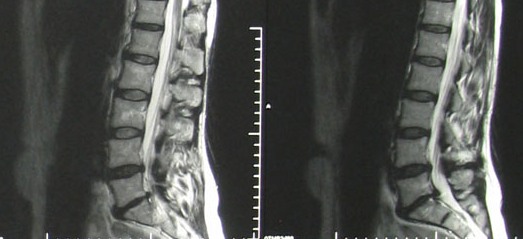 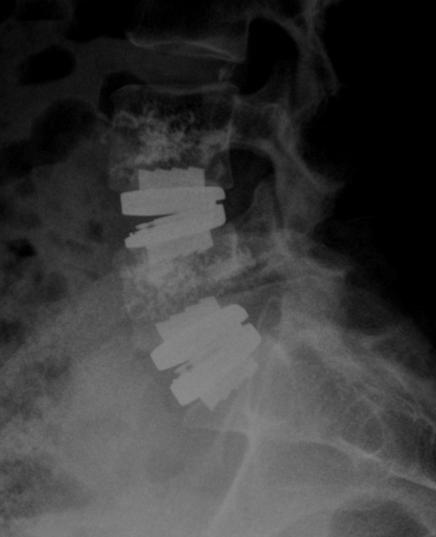
__________________
1997 MVA 2000 L4-5 Microdiscectomy/laminotomy 2001 L5-S1 Micro-d/lami 2002 L4-S1 Charite' ADR - SUCCESS! 2009 C3-C4, C5-C6-C7, T1-T2 ProDisc-C Nova Summer 2009, more bad thoracic discs! Life After Surgery Website President: Global Patient Network, Inc. Founder: www.iSpine.org
|
|
05-19-2008, 02:47 AM
|
|||
|
|||
|
That "50% disc height' rule doesn't sound right. My disc was down to 4 mm, when it should've been 21mm. Another member had his bone-on-bone, and starting to fuse when the disc was implanted. Was that the surgeon's opinion? Something from the implant manufacturer? I'd ask a whole bunch of questions about that, if I were you.
__________________
Herniated disc lifting at age 19 Laminectomy at L4-5 in 1998, repeat in 2001 same level 13 docs, 9 PT's, 8 Epidurals, 3 trigger point inj, 1 Facet Block, 1 Acupuncturist, 3 Chiros and 1 child later, had L4-5 ProDisc placed 9-19-06 by Dr. Janssen in Denver, CO. Facet rhizo March, 2007, November 2007, January 2009 Had healthy baby boy #2 in Dec 2008 with use of some meds during pregnancy and nursing.
|
|
05-20-2008, 09:04 PM
|
||||
|
||||
|
I think that everyone understands that the info presented here is good for what it's worth... stuff posted on the internet. Some items are absolute nuggets of gold, and some are harmful misinformation. It's up to the reader to look at the information available and take what good they can... and hopefully contribute in a manner that will benefit the community. That's the internet at it's best. I credit the braintalk forum with saving my life... had I not found them I would have had a 2-level BAK fusion with no posterior instrumentation. Because of the info I discovered there, I came to understand that I was responsible for learning what I could to make informed decisions about my care.
This is a great discussion and I'm glad we are having it because it's a microcosm of what we face as patients... go to 5 doctors and get 8 different opinions. All are experts... how do we decide? Unfortunately, too many of us are naive about the situation and often are on the wrong side of failed spine surgery before we understand that we need to take responsibility for our care, be good consumers and make informed decisions. We grew up in a world in which we... get sick... go to the doctor... do what he says... and we expect to get better. I've seen too many people who are abandoned by their health care providers and told that they have no options other than chronic pain and disability... only to discover that they do have options. Some will try those options and fail, but many will also succeed. However, when we are empowered to ask the right questions and seek the right information... WE get to make the decisions. WE get to take the risk. To some people, this will sound like doctor shopping and recognize that in some situations, patients are looking for a doctor that will tell them what they want to hear... and that may be the worst possible scenario... going until you find a doctor who is willing to do something that all the other doctors know is out of bounds. In other cases it results in finding a doctor willing to take on the difficult cases who actually knows that the patient who looks out of bounds stands a reasonable chance of success. If the patient is successful, the doctor is a genius. If not, the doctor doesn't look so hot. Look at the flute players case... www.fluteguy.com and on the GPN story page (BradleyL). He's more than 2 years out now, having a normal life. (Unfortunately, the trip to Miami made it so I couldn't attend the release party for his new CD. He's doing great.) His case was way out of bounds and he went to many doctors and got many opinions. All were against the surgery that was ultimately performed... except one. The point is that the PATIENT gets to decide. They get to take the risks. They have to live with the results. Get multiple opinions. Don't take anything at face value. Find a way to separate the marketing spin and competing interests from the information that is really relevant to your decision. In many cases, this is an impossible task. Even though it's overwhelming and we may ultimately have to make a decision realizing that certain knowledge of the best course is not something we can achieve... we still have to try... because we take the risk... we have to live with the results. We also must understand that even if we do have certain knowledge of the best course to take... we still may fail. Some rules are there to protect the patients from surgeons of less than average ability, yet they keep others from getting the best care from better surgeons. Some rules are there to protect the manufacturer from liability. It's a shame that spine surgery isn't automatic and that there is so much that is poorly understood, but it is. Do your homework... make informed decisions. Mark
__________________
1997 MVA 2000 L4-5 Microdiscectomy/laminotomy 2001 L5-S1 Micro-d/lami 2002 L4-S1 Charite' ADR - SUCCESS! 2009 C3-C4, C5-C6-C7, T1-T2 ProDisc-C Nova Summer 2009, more bad thoracic discs! Life After Surgery Website President: Global Patient Network, Inc. Founder: www.iSpine.org
|
|
05-21-2008, 12:16 AM
|
|||
|
|||
|
It is confusing!
Reminds me of the movie "Rashomon" re: differing viewpoints. Thus, if I have less than 5mm disc space, ADR is contradicted. I've never read this before - thanks. Last edited by ans; 05-21-2008 at 12:18 AM.
|
|
05-21-2008, 03:50 PM
|
||||
|
||||
|
Job13,
If anything, our medical community is known for it's secrecy. Finding a doctor today that is more concerned with a patient's welfare instead of their own self serving needs is rare today, especially for specialties. I was amazed that my neuro, knowing that other procedures existed, failed to tell me about them because he didn't perform them and because it had not yet passed FDA trials, was not legally bound. However, he was more than happy to perform another diso/lami knowing, yet failing to tell me, that the success rate was drastically reduced and would more than likely lead to further DDD. This is only 1 example of why it is so necessary for patients to become educated, not to believe everything they're told, and get more than 1opinion. Even on this forum, some sing the praises of doctors with whom others have had negative experiences. Even medications, designed to help have been known to kill and only after the fact does the truth come out that these dangers were known all along. Manufacturing warnings are meant more to protect the manufacturer than the public. In today's day, legalities and rightousness have little to do with each other. Bottom line, read, learn, ask questions, make up your own mind. It's your body, your suffering and your possible relief.
__________________
3 level Prodisc adr S1-L3, Oct 12, 2005 Dr. B in Bogen, Germany Severe nerve damage in left leg, still working on it
|
|
05-21-2008, 06:51 PM
|
||||
|
||||
|
Quote:
Quote:
I don't agree that anything goes in Germany. Just as in the US, there are careful surgeons and less than careful surgeons. There are surgeons willing to take on the tough cases and push the envelope, and there are surgeons who will stop at every 'hard and fast' rule and never take on a tough case. If someone with a totally collapsed disc gets ADR and fails, they may look at what I've written here as harmful misinformation. If that person has a wonderful result, they may view what you've posted in that way. This is why it is foolhardy to base a medical decision upon what is found on the internet. Hopefully, what we find will be useful information. Hopefully, it will cause us to ask more questions, seek more options and be very careful about our decisions. Quote:
So while some think that the answer will be in the data... I don't agree. Even if the answer is in the data... with success rates in the 80's, what does the data mean for the people who are on the wrong side of the equation? The useful information to glean from the data is the harsh reality of failed spine surgery. I believe that the success rates are overstated, that there are ways to manipulate the data, and that as long as the financial interests are so great, there will always be good reason to take it all with a grain of salt. Quote:
I'll hold a patient conference and look over a room with 70 spine patients in it and think that 80% success means that 14 people out of this small group will not be successful. This is why we must ask the questions, discover the options, do our homework and make informed decisions... our lives depend upon it. The patient ultimately chooses and the patient must deal with the outcome.
__________________
1997 MVA 2000 L4-5 Microdiscectomy/laminotomy 2001 L5-S1 Micro-d/lami 2002 L4-S1 Charite' ADR - SUCCESS! 2009 C3-C4, C5-C6-C7, T1-T2 ProDisc-C Nova Summer 2009, more bad thoracic discs! Life After Surgery Website President: Global Patient Network, Inc. Founder: www.iSpine.org Last edited by mmglobal; 05-21-2008 at 06:53 PM.
|
|
05-21-2008, 10:38 PM
|
|||
|
|||
|
One of the interesting exchanges I observed at SAS in Miami was during a Q&A panel discussion after one of the lumbar ADR session. A surgeon came up to the microphone and while framing a question about retrograde ejaculation said something like, "What do you tell your patients regarding retrograde ejaculation? Do you have them use a sperm bank? My experience is that if you tell them a 2% chance exists, they will NOT believe it can happen to them. I tell them, 'What if you are in the 2%'?" This was more of a lesson for the audience than a question. He was trying to let everyone know that they should actively try to get males who may want children in the future, to take seriously the risk of RE and use a sperm bank. 2% is not never.
Risks can be small, but they can still happen to you. As a nurse, working on a busy surgical floor for many years, I've seen many post-op complications - some small, some major - and NOT always in the patients with the highest risk factors. We wish we never had to have surgery, but sometimes it's necessary, in spite of the risks that we must accept. Diane
__________________
RN - never a back problem until May 2007 Endoscopic discectomy L5-S1, Dr. Hoogland, AlphaKlinik, Munich, Germany - July 2007 2-level (L4-S1) ProDisc ADR, Dr. Bertagnoli, Bogen, Germany - March 2008
|
|
05-24-2008, 05:52 PM
|
|||
|
|||
|
Quite a confusing conversation. Especially if your a suffering patient just looking for clues on what is better: fusion/ADR ... and in what cases.
What I read here: Do your homework, read, learn, question ... and simultaneously ... do not trust published data (i.e., what you read), do not trust your surgeon's answers to your questions, and much of what you learn (especially on the internet ...like on forums) is apparently garbage or dangerously misleading. One person says - decide on your procedure, then find a doctor who agrees. In other words, you must be smarter and more knowledgeable than the surgeons themselves. How can you do this? Attend conferences? No, of course not. You can barely move. Ask multiple doctors? Of course not ... again, you can barely breath, much less sit for hours in a waiting room. Send email? Forget it. No doctor is going to give medical advice except in person. Count the happy people vs. sad people post surgery on forums? Not after seeing the misrepresentation, defamation, censorship and banning of failure case we see on sites like ADRsupport. In any case, we can easily see in the member lists that the successful people's posts of 'encouragement' outnumber the failure warnings 1000 to 1. Believe it or not, I studied like mad (on ADR) before leading my wife into this hell. EVERYTHING said ADR was supperior in every respect. Now, I feel like a Joseph Fritzl ... going to work, stores, sleeping free of pain ... while my wife is facing FIFTY years at least of hell. A destroyed leg, and the consequences of a late lateral explantation of a Prodisc. Hard to believe this was my wife only 3 years ago ... before we were tricked into 'volunteering' for someone's sick experiment ... for data that no one believes. So, as Mark said on ADRsupport long ago: "This is a dangerous landscape. We can't trust the studies... we can't trust the statistics... we can't trust the anectodal evidence... we can't trust the doctors to always know what's right, or to always tell us the truth... and on and on." I doubt you will be able to find that quote on ADRsupport ... as H has locked the doors, so to speak. By invitation only. So, this begs the question: Who/What do you trust? Obviously, the first to exclude are those who have a financial conflict of interest. Next would be data which is not double-blind class I controlled (i.e., basically everything from Europe is self-monitored). Third would be, anyone who suggests that a selected set of success stories from forum members is justification for ignoring the generally accepted practices (rules). Some of those people, even have the audacity to suggest that facet arthrosis is not a contraindication ... and then kick everyone who dissents off their board. Question (back to Sharman's original question - regarding 'fit'): Does anyone know what the minimum height of the Prodisc-L is, and resultingly, what is then the minimum height of a person's natural disc? Question 2: What grade of facet arthrosis is a contraindication to ADR? Yours, Matt
|
|
05-24-2008, 08:14 PM
|
||||
|
||||
|
Matt,
Your pain in so evident in your post. What you and A have been through, are going through, will go through, no one should have to. I am sorry that you find yourself in this position. I think your post demonstrates the need for educating oneself more than ever. If learned, studied doctors have differing opinions, how does anyone know which is the truth? Excellent question. And no, I don't believe someone should chart their own course and then find a doctor who agrees with them. First, any surgery has it's own risk. When the spine in involved, this decision is multiplied too many times over. The best advice, which I still stand by, is the excellence and reputation of your doctor. A is the proof that even that criteria isn't fool proof. I too had a bad experience with a renowned surgeon. So what can someone do to insure this doesn't happen to them? The truth is I don't think they can. Bad things happen even with the best advice/intentions. Bad things happen under the guise of basic medical care. I've no doubt, based on insurance approval and despite known contr-indications, I could have found 10 doctors who would have fused my 4 lumbar discs. Would this have been wrong? I honestly don't have the answer to that one. In short, there is no cut and dry answer to too many medical questions. Everyone has to decide for themselves which information they find valuable and which to throw in the trash and the only way is to educate themselves. If an answer has leanings, go with the leanings. If 50/50, try to find examples. Are you wrong because you disagree? Are you right because others agree with you? I don't think, at least not in our lifetime, spinal procedures will progress to any definitive procedures. It's people like us that will pave the way. In the meantime and because of all the above, we owe it to ourselves to do the best we can with the best we have. I do believe that one day it will be simple but as to when is only in those evasive crystal balls. I hope you and A find the relief you seek and this nightmare finally ends. Dale
__________________
3 level Prodisc adr S1-L3, Oct 12, 2005 Dr. B in Bogen, Germany Severe nerve damage in left leg, still working on it
|
|
05-25-2008, 05:32 AM
|
|||
|
|||
|
Matt,
I'm sorry that you are experiencing this spinal hell. Watching a loved one in pain is difficult and exhausting. It's been five years since Mark's chronic pain, and it's still difficult for me to think back to those days. Don't feel guilty about being able to live yourself. If I wasn't so busy with work, childcare and housework, I don't know if I would have made it. You need to take care of yourself so you can remain supportive. I was fortunate to have a best friend who would call me up and take me out even when I tried to decline. Don't beat yourself up about the decision for ADR, sounds like you did your research. I'm sure it wasn't all your decision. As far as ADR vs fusion I don't have any magical answers. I'm happy the first ADR patient 24 years ago was willing to try the procedure. He still plays tennis and because of him I have a chance with my ADR. Don't give up, recovery can be a long process. When Mark was at his lowest point, we got a puppy. I know that sounds crazy! Who needs the extra work, but it worked magic. Maybe an older dog would be easier, but they are great for companionship. Diane
__________________
RN - never a back problem until May 2007 Endoscopic discectomy L5-S1, Dr. Hoogland, AlphaKlinik, Munich, Germany - July 2007 2-level (L4-S1) ProDisc ADR, Dr. Bertagnoli, Bogen, Germany - March 2008
|
|
05-25-2008, 04:19 PM
|
||||
|
||||
|
I don't think I can properly express how much of a difference getting Taffy made to me at a time when I was pretty severely disabled and depressed. Diane was brilliant in making this happen. After Taffy was older, the companionship was important, but right from the start, things were different. I suddenly had something I needed to care for, as opposed to the focus on my pain and my problems. I suddenly had something that made me laugh and smile a hundred times a day. Fortunately, Taffy was a service puppy, so she came with an instruction manual. (I wish our kids came with one!) We had a job to do... not only was it fun and rewarding training her, but it also made Taffy a well trained dog that is so much easier to handle.
I wish I could write more now... gottal run! Mark
__________________
1997 MVA 2000 L4-5 Microdiscectomy/laminotomy 2001 L5-S1 Micro-d/lami 2002 L4-S1 Charite' ADR - SUCCESS! 2009 C3-C4, C5-C6-C7, T1-T2 ProDisc-C Nova Summer 2009, more bad thoracic discs! Life After Surgery Website President: Global Patient Network, Inc. Founder: www.iSpine.org
|
|
05-25-2008, 06:27 PM
|
|||
|
|||
|
Dear Diane & Dale,
Congratulations on your successes (including families, children, friends and puppies.) I would love to have a puppy myself, but for Anastasia - with a destroyed leg and weakened back, having a boisterous puppy is probably not a good idea - no matter how much I beg. Thanks for the concern about me ... but trust me, feeling sorry for me is the last thing anyone should do. I have no pain and a full life. My point here is to emphasis that I did a hell of a lot of research ... only to find out later that it was all lies. I heard this from several German surgeons too. I'm not beating myself up on our ADR decision ... we were sure we chose the best surgeon with the best device ... given everything we read, studies, comparisons, wear rates, ... everything. If I could have done more, (like I didnt do with the knee surgery), then I would be distraught with guilt. What I'm disturbed about, is that no-one even discussed fusion. Maybe it was our pure bad-luck to be living in Germany. Maybe its was our dumb luck to have read through ADRsupport at all the oozing praise of these surgeons. I studied everything, and eventually came up with the conclusions that: 1) The Prodisc has a 94% success rate in 60 year olds, 98.2% success in single-levels with average ages in the 45+ range, and no bad outcomes - compared to much worse results with the Charite. According to Dr. B. My 31 year-old wife had 1 level (l4/5) DDD, everything else perfect ... (but that was according to images from nearly 1 year before the ADR surgery.) Now I know those Prodisc numbers are not class I data. Not that it is relevant to our situation - since my wife was not a candidate at all. If she was a perfect candidate, I think everyone would agree that choosing a device with 98.2% success is better than something with 64% success, versus 58% for (BAK) fusion. Or maybe we should revisit, and look at the Charite vs. Prodisc, with 93.9% (Charite) vs 83.3% (Prodisc). In any case, the FDA's results on the Prodisc were more like 53% ... but I didnt know that at the time. 2.) The AK and Sten'm are financially driven institutions, according to several German doctors. However, Dr. B. appeared as an academic. I like professors - they are only interested in improving humanity. They dont care about money. They will take a special interest in every patient. That is what I thought. Too bad they ignored our begging for a review session ... since 5 months before, and 3 months after the surgery. The surgeon Never even visited for a moment. Now I suspect he is probably more financially involved than all the rest combined. 3) I believed that the other institutions were assembly machines. We had already seen how the knee surgeon at AK never even saw us ... even after 4 extremely painful trips. He was too busy in his assembly line. We were foolish enough to trust the salesman, that they were going to do as written - check for a torn medial meniscus. They lied. We have written reports from many surgeons (including German), that her Patella was perfectly healthy. But, in any case, I was totally stricken when the ADR surgeon never even visited once afterwards. We were in the hospital 7 days, and in a hotel nearby 2 weeks. We begged ... and were totally ignored. 4) I read that fusion is horrible compared to ADR. That there is a 9% chance of revision surgery with fusion, lots of blood loss, an extremely long recovery period, a need for posterior screws, a high rate of morbidity with ICB (iliac crest bone), you will be stiff as a grandma, and the rest of your discs will blow sequentially. That, as I recall it, was my honest perception. You will note, none of the ADR kliniks tell you about the modern versions of fusion with 99% fusion rates, no need for ICB due to rhBMP-2 (bone morphogenic protein), the new PEEK cages which are MRI translucent, the minimally invasive (MAST) fusion techniques ... or even the micro-invasive techniques of injecting BMP into the disc which has been shown to stimulation regeneration. Even those damned trials compare ADR against failed fusion techniques (BAK). Its Criminal. 5) I was told that, in the case of failure of the Prodisc, it would be simple to revise it to either a different device or a fusion. I was not told that every surgeon in Germany would refuse to revise, because the scarring over of the veins would make it impossible to remove except laterally. It was not revealed that lateral explantation would require a huge osteotomy (remove of vertebral bone) ... and severing of the sympathetic nerves running through the psoas - leading to horrors that you dont want to hear about. I found this all out later. Of course, you cant expect your surgeon to tell you all those details ... but you can expect someone (i.e. Synthes) to have addressed the concern ... since we can in fact expect a lot of them to fail. 6) I was not told that, the Prodisc only comes in 3 sizes (10, 12, 14mm), while the Charite has a lot more - down to 6.5mm in height. Also, the Prodisc has a minimum lordosis of 6 degrees, so if your natural segmental lordosis is very small, they will jam this thing in you, bending you backwards into hyperlordosis, permanently. If your natural disc height is small, then the Prodisc will jack you up ... and guess what ... its not just about distraction. Its your whole spinal unit. Its designed to fit perfectly ... which means the facet joints are only designed to work with an exact height of the disc. Its like a gate. If you mess up the hinge's height, the latch completely misses. Except, in spines, the missing causes tearing and crushing of facet cartilage. This probably explains the 32% facet degeneration reported post ADR. In summary, we have been run over by the loco of ADR, its financially conflicted proponents who publish outlandishly high rates of success, zeolots who present only the positives on ADR ... and not the litany of dangers. We have naively thought that certain surgeons are only academically driven, when it turns out that they have a huge financial interest. We were fooled into thinking the surgeon would make a thorough review beforehand, choose the best possible solution out of all available, and that he would give every bit of concern and compassion in follow-up ... not treat us as a legal nuisance. So, anyway. Sharman is asking for advice about ADR vs. Fusion ... and everyone is saying - you need to educate yourself ... or praising the thoroughness on his questions... or talking on some other subject (uh, me included). But no one will address the questions directly ... we are basically saying go find your information elsewhere - while also saying that info is bogus. We all believe that ADR is better than fusion ... at least in the short run ... if all the patient selection criteria are met ... and the surgeon is highly trained and skilled ... and the surgeon is not financially biased to use an inappropriate device or technique ... and the patient has a thorough understanding of the risks and expectations (15% pain reduction = success), and the surgeon is going to openly and honestly take responsibility for whatever results instead of trying to cover up a major blunder and just hope the patient goes away ... like all the others. I leave you with a few key quotations: "Disk replacement is appropriate during the narrow time window when degeneration is limited only to the disc and signs of instability or degeneration of the posterior elements have not yet appeared. Limited by this time window and the inclusion criteria dictated by the US Food and Drug Administration (FDA) for disk replacement, only 7.7% of patients admitted for lumbar spine fusion during the study period were found suitable for disk replacement. " http://www.orthosupersite.com/print.asp?rID=25668 "the FDA and DePuy Spine recognize the limitations of the available data. They restrict use to a relatively narrow indication" medscape "Disc Arthroplasty changed my practice completely: Today, after 6 years experience, Disc Arthroplasty has replaced ~ 90% of my Fusion Procedures!" Dr. B. "Reoperation Rate After Instrumented Posterior Lumbar Interbody Fusion: In the present study of 1680 patients, the revision rate amounts to 13.2%" "Suboptimal patient selection and/or surgical technique accounted for the majority of failed disc arthroplasties." spine Article which debunks adjacent segment degen with fusion
|
|
05-25-2008, 06:52 PM
|
||||
|
||||
|
Quote:
__________________
2006-2009 on/off burning leg pain 07.2006 Microdiscectomy 04.2004 Herniation L5-S1
|
|
05-25-2008, 07:01 PM
|
|||
|
|||
|
re a puppy
The only thing I have to add here is in response to the puppy idea. I got Lola and the thing that used to bother me so much was walking yet now I can walk and walk. I thank Lola for that. She gave me a reason to walk as well as the daily motivation. She's not a well trained dog and in fact she's terribly spoiled and has a mind of her own as mini schnauzers do but thanks to Lola I'm quite the walker now and even lost the excess 10 plus pounds I had been carrying around for years.
BTW, Taffy is a really sweet dog. Lola's companion, Leila is a nearly 8 y.o. lab (my stepson's) and she is so well trained and great to walk as well. In fact she doesn't need the leash at all. Should anyone get a dog to walk, make sure that the dog isn't walking you. That can lead to problems with tugging of one's own body parts which may lead to flare ups of injured parts. While I can pretty easily walk Lola alone, walking Lei and Lo together has lead to flare ups with my c-spine. This is a bit off topic re what's better, ADR or fusion. I say dog walking in my own case for now is better than either since I've not yet had further surgery....
|
|
05-25-2008, 09:47 PM
|
|||
|
|||
|
I never researched the most recent fusion modalities success rates. An other forum is filled with the emotional debris of failed fusions. I have extensive DDD (L -2 to L-5), questionable facets acc'd to MRIs, and adjacent segment syndrome's a concern. Nice summarization job but sorry you had to do it.
+ + There's substantial literature on "pet therapy" and how this helps people heal better and diminishes depression. Even hardened prisoners love caring for animals. Remember how Koko mourned (warning: hokey music): http://diabellalovescats.com/koko.htm
|
|
05-25-2008, 10:08 PM
|
|||
|
|||
|
Clarification
"Maybe it was our pure bad-luck to be living in Germany" ...
Meaning, in the USA, with the Prodisc not approved, we probably would not have had so much access to so many clinics (Stenum, AK, Pro_Spine) ... which specialize in ADR. Of course, we thought it was amazingly good luck at the time, that we lived only 1 hour from Straubing, and 30 minutes from AK. Of course, if we were natives, we may have had more success finding other Orthopaedic clinics. Let me balance my criticism: Over half of the FDA Prodisc trial surgeons in the USA had financial conflicts of interest. They should be fined at least - for the amount invested. The Prodisc FDA approve must, by Federal law, be thrown out. That's not from me, its from the Senate Finance Committee, headed by Senator Grassley. I do not subscribe to the line that the surgeon must invest in a company in order to improve the technology. They should put themselves above it - its their oath. Please note, we did get a lot of inputs from German neurosurgeons AFTER the ADR ... but that was only because I found a site listing ever Prodisc specialist in Germany ... and emailed to every one of them. It would be great if you could post the names of the surgeons/kliniken who have more conservative views on ADR. Thanks! Best Regards, Matt
|
|
05-25-2008, 11:06 PM
|
|||
|
|||
|
Matt: given all the (perhaps rightful) criticisms of ADR/ProDisc, there have been some outstanding successes (and w/Charite). I wonder, given both of these ADR's shortcomings, what happens to make a sucessful ADR? I'm thinking of excellent placement, no pain relief from facet injections, etc. I hope I don't seem insensitive, I'm not. Maybe there's some factors that have not been fully recognized. (As I'm in the middle area of MRIs showing facet "arthroses", the nuances of this maze confuse me). With Regards ~ Allan
Last edited by ans; 05-25-2008 at 11:32 PM.
|
|
05-25-2008, 11:56 PM
|
||||
|
||||
|
I did go to AlphaKlink. Many reasons for that. Dr. Z. did a fusion on my L5/S1 even though he originally offered ADR. He did not charge me extra for the fusion, which normally goes for 3000 euros more, which he did using my own bone, again, for a very good reason. After taking double xrays he spotted a minute shift in my L5 vertabrae on flexion. He said it was not worth to risk putting ADR there but to do fusion instead so now I have 1 fusion and 1 adr, with no complications. The improvement was immediate. Ask Mark, I met him there and he saw me walking better then in 7 years, after only 1 month. This shows that they will not just do ADR no matter what. They do reject patients as well. I know of several.
I have researched this since 2000 and read a lot of the negative stuff. In US they told me don't have surgery, its bad news, its too risky, the word "guinea pig" came up. Live with it. Go home. PT, pain killers what ever. I read and read and read. Everytime I had another level 10 episode I read again. So when I finally showed up in Germany it all fell in place with everything I knew and read. Yes, I personally felt that there was more "money" behind Bertagnoli" then with Zeegers *EVEN* though the Alpha is so darn flashy that all one can think is whoah, there is a lot of money in this place. I went there 4 month before I actually had the surgery so I had time to think. But then if they did bad operations all the time there would not be there anymore with that big sign on the front. So I know I was taking a big risk when I walked in the back door and layed down on that stretcher and prayed when they stuffed the IV in that all the bad stuff I had read about would not happen to ME because it probably would and I don't like gambles, I never go to casinos and I did it anyway, even with all the concerns. I guess I hurt long enough and knew that was the only way it could get better. Mind you 10+ years of this backpain sh*t, getting worse every year. ADR vs fusion. The STALIF fusion that Z. did to me worked fine out the door. Yes, the hip site hurt, real good. But if you need to decide weather to have fusion at L5/S1 don't rule it out. It seems like it worked just fine, just as good as the ADR above so I am somewhat glad I only have 1 ADR...
__________________
Nov 07: STALIF Fusion L5/S1 ACTIV-L ADR L4/L5 Nov 09: Prodisc-C ADR 2 level C 4/5/6
|
|
05-26-2008, 07:34 AM
|
|||
|
|||
|
Hi Ans: Please note, I have not criticized ADR/Prodisc. IF the stats were true, (as I believed), I would be all for it. That's why we chose it. If your conditions indicated ADR strictly (as nearly ALL surgeons state ... including Dr. B.) then you will fit those high stats. If a surgeon disregards the indications, then you no longer benefit from the stats. The trials used highly selected patients - perfect candidates. If your facets are half-blown, then forget about the stats.
My points were: 1) The success stats highly correlate with the degree of financial investment of some surgeons 2) No one even discussed fusion - ever. My wife was absolutely contraindicated. I got this from numerous US/UK/FR/NL/DE surgeons afterwards. 3) We were told revision would be easy. We were very concerned about the keels. We were not told that everyone in Germany would refused to do it. 4) We were appalled that the surgeon never even visited ... even though it had been 5 months since our original visit - where our images were already 5 months old. He never even said hi ... until 3 months later ... with a legal team. Fuzzy: We agree that Dr. Zeegers is incredibly nice and accessible. Our beef is with the knee surgeon ... who did not show up for any of the 4 visits we made specifically to see him. In any case, AK did say 'ADR' for us ... and nothing else. I didnt mean to imply that AK or Stenum or ProSpine never do fusion. The question is really: Do they ignore the rules when desired ... although following them strictly in their stat gathering trials? Some here say that facet arthrosis is NOT a contraindication, and that a collapsed disc is also not. I say that is crazy. Cheers, Matt
|
|
05-26-2008, 07:43 AM
|
|||
|
|||
|
Thanks for clarifying M. I have a bad chest cold and am not quite "here". My sense is to beware re: facet arthropathy and ADR - 'tho I wonder if others e.g. Active - L might be better.
Again, my sentiments - I'm sorry you two have to go through all this. I hope that A continues to mend and regain her spirited life. Best, Allan
|
|
05-26-2008, 08:33 AM
|
||||
|
||||
|
Quote:
1. Orthozentrum München - from ADR's they do Prodisc only and said that it would be difficult/impossible to remove it. Suggested PT, microdiscectomy, fussion. 2. Klinikum Grosshadern - again do only Prodisc, but suggested microdiscectomy and fussion down the road. 3. Alphaklinkik - ADR (Active-L). 4. Neurochirurgie Innenstadt München - ESI, microdiscectomy, said that ADR was a big thing 1-2 years ago but they do not recommend it anymore because they didn't have a very good experience (didn't ask why). 5. Neurochirurgie Dr.Obermüller & Dr.Fritsch - well, they do surgeries only (~2500 a year) - not a big surprise that they against ADR's. Recommended microdiscectomy - and I think I'll go for it...
__________________
2006-2009 on/off burning leg pain 07.2006 Microdiscectomy 04.2004 Herniation L5-S1
|
|
05-26-2008, 01:16 PM
|
|||
|
|||
|
To Blair and Sharman
Blair: By the grace of God (maybe surgeon too!) are you doing so well and I hope that this continues.
+ + Sharman: Hola. Thank you for your advice. I like it! Never considered biologics as a later precaution (if there is one) against adjacent syndrome thingie. The DDD creeps me out. Best of luck to both of you and have a nice holiday. Allan, in LA
|
|
05-26-2008, 04:00 PM
|
|||
|
|||
|
Sorry for interrupting ans/blair/sharman ...
Thanks B13! 1. Orthozentrum München - Dr. Mayer and Siepe. You have probably seen their papers where they point out that Dr. B's results are $%^! Therefore, I was really impressed with their candor ... Another surgeon told us that Dr. Mayer refused to ever take another Prodisc out ... because he had a very very bad experience. You guess. 5. Neurochirurgie Dr.Obermüller & Dr.Fritsch: I met one of them - very nice guy, fluent English too. They also offered to do a minimal-invasive on A way back in 2005 ... but we passed because they said it would be open-back ... i.e., not exactly micro. We eventually had it done by emergency with the AK ... which was endoscopic. They, of course, know nothing of ADR revisions. Best wishes and regards ... M
|
|
05-27-2008, 09:16 AM
|
||||
|
||||
|
Quote:
And incision is quite small - ~ 2cm - you cannot really call it open-back.
__________________
2006-2009 on/off burning leg pain 07.2006 Microdiscectomy 04.2004 Herniation L5-S1 Last edited by B13s; 05-27-2008 at 09:23 AM.
|
|
05-27-2008, 09:42 PM
|
|||
|
|||
|
Just a note about the disc height question. I don't have any info on normal disc height, or what sizes ProDisc comes in. All I know is what my surgeon told me: I watched him with a ruler measuring my X-ray before surgery, with 4mm between the vertebra, and after, with 21mm. That's just what he said. Matt&Anastasia, I wanted to say that I'm sorry that despite all diligence on your part, the research, the time, the questions asked, that it didn't work out for you! It seems you did everything you could, and to still have a bad outcome...
  I'm so sorry! It's so hard not to be excited by a procedure that worked for you, and want that success, thus that procedure for others, but it may not be right. Puts things in perspective. I'm sorry that you'll have permanent pain and damage! No one should have to live with that, but I hope you can find peace and happiness in this world, however you can! Hang in there, and thanks for sharing so much of your story! I'm so sorry! It's so hard not to be excited by a procedure that worked for you, and want that success, thus that procedure for others, but it may not be right. Puts things in perspective. I'm sorry that you'll have permanent pain and damage! No one should have to live with that, but I hope you can find peace and happiness in this world, however you can! Hang in there, and thanks for sharing so much of your story!
__________________
Herniated disc lifting at age 19 Laminectomy at L4-5 in 1998, repeat in 2001 same level 13 docs, 9 PT's, 8 Epidurals, 3 trigger point inj, 1 Facet Block, 1 Acupuncturist, 3 Chiros and 1 child later, had L4-5 ProDisc placed 9-19-06 by Dr. Janssen in Denver, CO. Facet rhizo March, 2007, November 2007, January 2009 Had healthy baby boy #2 in Dec 2008 with use of some meds during pregnancy and nursing.
|
|
05-28-2008, 12:02 AM
|
||||
|
||||
|
Quote:
Note that there are trade-off and that micro-d surgeons will say that they can see better and accomplish more effective decompression. I wonder if I'd be in better shape if I'd had endoscopic procedures instead of the 2 microdiscectomies I had prior to my ADR surgery. For Diane's (my wife's) discectomy, we went to Hoogland at the AK and he did an excellent job decompressing a disc bulge that others would not consider doing endoscopically. While that surgery was successful in accomplishing what it was designed to do... she had a great recovery and continued to improve for 2.5 months. Unfortunately, the disc was too severely compromised and she went south again and ultimately had 2-level ProDisc with Bertagnoli last March. With her apparent success from her ADR procedure, we wonder how much better off she is having gone endoscopic instead of open? Mark
__________________
1997 MVA 2000 L4-5 Microdiscectomy/laminotomy 2001 L5-S1 Micro-d/lami 2002 L4-S1 Charite' ADR - SUCCESS! 2009 C3-C4, C5-C6-C7, T1-T2 ProDisc-C Nova Summer 2009, more bad thoracic discs! Life After Surgery Website President: Global Patient Network, Inc. Founder: www.iSpine.org
|
|
05-28-2008, 09:26 PM
|
|||
|
|||

Michelle: Thanks.
Its odd to hear that surgeons still use a ruler on Xrays. The radiographic analysis software is very advanced these days. Various papers reveal measurements in the order of microns (1/1000 mm). I was really impressed with the measurement tools in Jview. WE know it is exact because we know the exact height of the Prodisc implanted (11mm in the center). Dicom, http://www.pubmedcentral.nih.gov/art...?artid=1888420 Also - here for example, Dr. James Yue states the disc height increases: Quote:
Thus this article authored by Yue and Bertagnoli: Quote:
 I think we have to be realistic and realize that a lot of people will be experiencing permanent pain ... especially if their ADR device is 1.5x too tall, their Pre-OP facets are Grade IV arthritic, and their pre-op disc was collapsed to bone-on-bone. In this case, we can be sure it wont work-out for 98.2% of the patients. My guess is maybe the number should be backwards - like 98.2% failure ... kinda like tramadol usage reduces from 26% to 30%. 
|
|
05-29-2008, 03:59 AM
|
|||
|
|||
|
Thanks Matt. I'm sure it was just what he had in his pocket at the time, looking at actual film X-rays. I never saw the official radiology report for those films, but when I looked back, he actually said it was 25mm, that 21 was the amount of height I'd gained from 4mm. What I actually asked him was how much height I'd gained overall, so I don't know what part of the disc he was measuring. Interesting at the heights of ProDisc available are so far different from that!
__________________
Herniated disc lifting at age 19 Laminectomy at L4-5 in 1998, repeat in 2001 same level 13 docs, 9 PT's, 8 Epidurals, 3 trigger point inj, 1 Facet Block, 1 Acupuncturist, 3 Chiros and 1 child later, had L4-5 ProDisc placed 9-19-06 by Dr. Janssen in Denver, CO. Facet rhizo March, 2007, November 2007, January 2009 Had healthy baby boy #2 in Dec 2008 with use of some meds during pregnancy and nursing.
|
|
05-30-2008, 12:32 AM
|
||||
|
||||
|
Disc height.
I gained 12mm in height after the surgery, the height of the Active-L disc. Measured on the xray with a ruler and measured myself before and after. All corresponds :-), Before the surgery there was only 4 mm AT MOST (in front) in disc height at L4/L5, disk space now 12mm, close to the levels above. The height of the fusion level was unchanged. Also I am closer to the height stated in my passport then I was before the surgery.
__________________
Nov 07: STALIF Fusion L5/S1 ACTIV-L ADR L4/L5 Nov 09: Prodisc-C ADR 2 level C 4/5/6 Last edited by fuzzy; 05-30-2008 at 03:16 AM.
|
|
05-30-2008, 03:15 PM
|
|||
|
|||
|
Hi Fuzzy,
Yours makes sense - when you say your current disc height is 12mm, and that is the exact heigh of the device. But, not meaning to 'nit-pick' ... if your pre-op height was 4mm, and you gained 12mm, then it should be 16mm. But, I guess they removed the disc material, so you must have actually only gained 8mm ???? Most important though, is that you note that the new disc height is basically the same as your natural disc heights ... so that your nerve root probably wasnt stretched nearly as much as it was decompressed back to normal ... and ... your facets will be callibrated (so long as they had not already become hypertophic) Here is an article that describes (obvious to some) this concept with disc height and the facets: http://www.spineuniverse.com/article...sion-2389.html ... If your disc thins and can't handle movement as effectively, then the facet joints can become overworked. Facet joints stabilize the spine by controlling movement, but when a disc loses height, the facet joints lose alignment and have to readjust their movement. They can become overworked because the disc isn't doing its part to control the spine's movement—that's a lot of pressure on the facets. If the facet joints are overworked, then the cartilage can wear away. Cartilage is meant to protect the joint and make movement easier. However, it can degenerate, leading to more facet joint problems. Without cartilage, the facets can move too much; this is called overriding. If the facet joints are overriding, then bone spurs can develop. Bone spurs are your body's way of trying to protect itself. These bony overgrowths, also called osteophytes, are meant to stop the facets' excessive movement. A side effect of bone spurs, though, is that they can pinch nerves as they grow into the area where the nerves are exiting the spine.
|
|
05-31-2008, 06:04 PM
|
||||
|
||||
|
Ok I was a little too general so I looked up the surgery report again. It took weeks for the anesthesia to wear off so it seems so all that is a little bit of a haze.
Yes, now after the surgery all my levels are the same, at about 12mm center height. The ADR they implanted was only 8.5mm (and "XL" size) but the diskspace looks to be more then that now. I gained a couple of mm at the fusion level as it too was reduced, just not as bad as L4/L5 where I was hitting bone on bone on extension which must have sheared of some of the disc acc to DR. Z., causing the neuro problems. So now I gained a net of about 8mm at L4/L5. The fusion level was about 7mm and now is 12mm. Dr. Z. used a 11mm STALIF peek spacer with 12mm bone grafts...as per surgery report. So 8mm at ADR level + 5mm gain at L5/S1 comes out to 13mm which adds up exactly to the before and after change in my bodyheight and the xray looks nice and symmetrical. Now that it is all aligned right all kinds of problems are gone including all the "mechanical" ones. Bone on bone crunching, pain, "locking up", wrong move really bad pain etc totally stiff in low back (now gone). I think if one has these kinds of problems (for years...)then one might be a good candidate for ADR. I am sure that not having all that stiffness is better for the rest of my spine in the long term, lets hope. Regarding the facets. I never had problems with the facets and my degeneration had been going on for years. I think my disc height had been reduced for 10 or more years with no damage to the facets, it seems. In fact when I fell off my motorbike as a teenager the ortho warned me that there was trouble ahead for my spine and to be careful what I do. This was in Germany at age 16.
__________________
Nov 07: STALIF Fusion L5/S1 ACTIV-L ADR L4/L5 Nov 09: Prodisc-C ADR 2 level C 4/5/6 Last edited by fuzzy; 05-31-2008 at 06:29 PM.
|
|
08-24-2008, 02:49 AM
|
|||
|
|||
|
Choose carefully - may limit future options
Thanks for all your comparison info. I've started the same thing, but waiting for diagnostic testing approval through WC.
I was told yesterday by my dr. office that if I get a fusion and if I need the disc replacement later (for example fusion failed), that I would not be able to get the ADR at the same level. BTW: Aetna, Kaiser Permanente and CIGNA cover the procedure, as well as Blue Cross Blue Shield plans in AR, NJ and MT.
|
|
08-24-2008, 04:50 PM
|
||||
|
||||
|
Racer, welcome to the forum. Thanks for your reply on KL's work com thread. Having someone with your HR knowledge here will be great.
Regarding your post (above). If one would be a candidate for ADR in the future at the operated level... then they must be a candidate for ADR now. I agree that it is safe to assume that attempting fusion will certainly burn many bridges for less invasive and less severe procedures. If a less invasive or less severe procedure is in play... that should be entertained before fusion. Mark
__________________
1997 MVA 2000 L4-5 Microdiscectomy/laminotomy 2001 L5-S1 Micro-d/lami 2002 L4-S1 Charite' ADR - SUCCESS! 2009 C3-C4, C5-C6-C7, T1-T2 ProDisc-C Nova Summer 2009, more bad thoracic discs! Life After Surgery Website President: Global Patient Network, Inc. Founder: www.iSpine.org
|
|
08-24-2008, 06:25 PM
|
|||
|
|||
|
Mark; thanks for the welcome.
My surgeon gave me 2 brochures: 1) fusion and 2) ADR. Without a discography, we can't tell whether I'm a candidate for ADR. Based on MRI, xrays and MRI, I could be, but the MRI doesn't give enough info to determine that. I just found out that the discography has been denied (WC) so now I'm starting that battle. The PA tried to convince me that fusion wasn't going to limit my flexibility, but she didn't succeed. Since the dr. gave me info on those two options, then I'm assuming I may be a candidate for ADR. My best friend had fusion and everytime I hear him tell me what he can't do, the more I'm convinced that ADR is the best choice for my lifestyle. I'm too active of a person to get fused and I'm afraid of the future risks and limitations. I have faith in new technology and willing to accept the risks for ADR. After all, I use to race mortorcyles against a bunch of guys going 160mph into a turn, ADR is nothing compared to that!
|
|
| Bookmarks |
|
|






 .
.


 Linear Mode


